The Heisei era saw gradual yet far-reaching transformations in Japanese society and culture. Globalization, shifting identities, evolving family structures, and changes in education and public discourse all reshaped everyday life, while popular culture―from manga and anime to foodways and sport―emerged as a powerful medium through which Japan engaged the world. How did Japanese society balance global pressures with cultural continuity? And what do these shifts reveal about Japan’s self-understanding at the turn of the twenty-first century? This volume, the fourth and final in the Examining Heisei Japan series, brings together influential essays on themes such as symbolic identity, the role of the public intellectual, cultural transmission, and the social implications of globalization, offering a wide-ranging view of the forces that shaped the era. The insights presented here remain essential for understanding Japanese society today.
Examining Heisei Japan series
This series, carried out in collaboration with the Japan Institute of International Affairs (JIIA), looks back at Japan's Heisei period (1989–2019) and the many changes and challenges that occured in the fields of diplomacy and security (vol. I), politics (vol. II), economy (vol. III), and society and culture (vol. IV). For more information on our book series with JIIA click here.
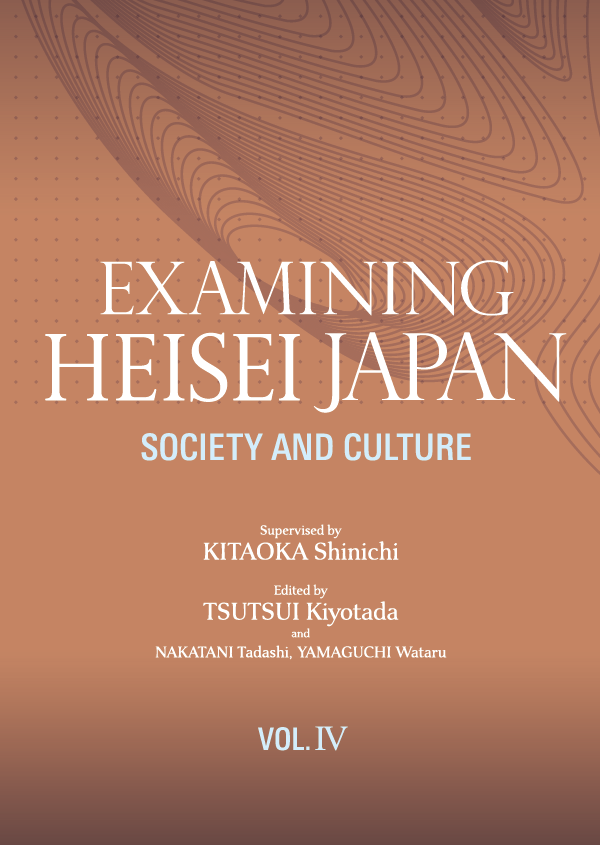
Examining Heisei Japan, Vol. IV
Society and Culture
Supervised by Kitaoka Shinichi
Edited by Tsutsui Kiyotada, Nakatani Tadashi, and Yamaguchi Wataru
JIIA series
Japan Publishing Industry Foundation for Culture
Social Sciences
ISBN 9784866582719 (ePub)
ISBN 9784866582726 (PDF)
KITAOKA Shinichi (Supervisor)
Kitaoka Shinichi is professor emeritus of the University of Tokyo and Rikkyo University and special advisor to the president of the Japan International Cooperation Agency (JICA). He received his PhD in modern Japanese politics and diplomacy from the University of Tokyo and subsequently taught at Rikkyo University and his alma mater. He has held posts as Japan’s ambassador extraordinary and plenipotentiary, and the deputy representative to the United Nations and president of the International University of Japan. He held the post of JICA president from 2015 to 2022. He has authored many English publications, including The Political History of Modern Japan: Foreign Relations and Domestic Politics (Routledge, 2018) and From Party Politics to Militarism in Japan, 1924–1941 (Lynne Rienner, 2021), and was supervising editor for A Western Pacific Union: Japan’s New Geopolitical Strategy (JPIC, 2023).
TSUTSUI Kiyotada (Chief Editor)
Tsutsui Kiyotada is professor emeritus and academic adviser at Teikyō University. He previously served as chair of the Department of Japanese Culture and dean of the Faculty of Liberal Arts at the same university. He is also a senior fellow at The Tokyo Foundation. He earned his BA, MA, and PhD from Kyoto University, where he taught for many years. His research focuses on modern and contemporary Japanese history and historical sociology. His publications include Saijō Yaso (Chūōkōron Shinsha, 2005), which received the 57th Yomiuri Prize for Literature in Criticism and Biography; Gendai shisō no shakaishi [A Social History of Contemporary Thought] (Bokutakusha, 1985); Ishibashi Tanzan (Chūōkōronsha, 1986); Nihongata “kyōyō” no unmei [The Fate of Japanese-Style Culture] (Iwanami Shoten, 1995); Jidaigeki eiga no shisō [The Philosophy of the Period Drama Film] (PHP Institute, 2000); Atarashii kyōyō o motomete [In Search of a New Liberal Education] (Chūōkōron Shinsha, 2000); Konoe Fumimaro (Iwanami Shoten, 2009); Senzen Nihon no popyurizumu [Populism in Prewar Japan] (Chūōkōron Shinsha, 2018); and Tennō, Korona, popyurizumu [The Emperor, Corona, and Populism] (Chikuma Shobō, 2022). He has also edited Kindai Nihon bunkaron [Studies in Modern Japanese Culture] (Iwanami Shoten, 1999–2000); Shōwashi kōgi: Sengo bunka-hen [Lectures on Shōwa History: Postwar Culture Volume] (Chikuma Shobō, 2022); and Fifteen Lectures on Showa Japan (JPIC, 2016).
NAKATANI Tadashi (Editor)
Nakatani Tadashi is professor in the Faculty of Law at Teikyō University. He graduated from the Department of History at Ryukoku University and earned his MA and PhD in politics from the Graduate School of Law, Doshisha University. He is the author of Tsuyoi Amerika to yowai Amerika no hazama de [Between the Mightiness and Feebleness of America] (Chikura Shobō, 2016), as well as numerous articles and book chapters. His research focuses on international history in the Asia-Pacific region during the interwar period and on the integration of international political theory and historical analysis.
YAMAGUCHI Wataru (Editor)
Yamaguchi Wataru is associate professor in the Faculty of Law at Teikyō University. He advanced to graduate school before completing his undergraduate degree and entered the Graduate School of Law, Doshisha University, where he earned both his MA and PhD in political science. He is the author of Reisen shūenki no Nichi-Bei kankei [US-Japan Relations in the Sunset of the Cold War] (Yoshikawa Kōbunkan, 2023), recipient of the Masayoshi Ohira Memorial Prize and the Inoki Masamichi Award, and Nichibei shunō kaidan [US Japan Summits] (Chūōkōron Shinsha, 2024). His research focuses on the history of the US-Japan alliance and on Japan’s foreign and defense policy in the 1980s. He is also a recipient of the Frank Gibney Award from the Journal of American-East Asian Relations.
AOKI Tamotsu (b. 1938) is a cultural anthropologist.
FUJIWARA Masahiko (b. 1943, Xinjing, Manchuria) is professor emeritus at Ochanomizu University.
INOUE Shōichi (b. 1955) is director-general of the International Research Center for Japanese Studies.
KAWAI Hayao (1928–2007, Sasayama, Hyōgo) was a clinical psychologist and honorary professor at Kyoto University.
KAWAMOTO Saburō (b. 1944, Tokyo) is a critic and essayist known for his writings on literature, film, manga, Tokyo, and travel.
MURAKAMI, Yōichirō Paul (b. 1936) is professor emeritus at both International Christian University and the University of Tokyo.
NODA Nobuo (1933–2020, Okayama) was a historian and professor emeritus at Kyoto University.
SATŌ Takumi (b. 1960, Hiroshima) is professor in the Department of Journalism, Faculty of Humanities, Sophia University; professor emeritus at Kyoto University; and visiting professor at the University of Tokyo.
YAMADA Masahiro (b. 1957, Tokyo) is professor in the Department of Sociology, Faculty of Letters, Chūō University and a life-guide correspondent for the Yomiuri Shimbun.
YAMAORI Tetsuo (b. 1931) is a former director and professor emeritus at the International Research Center for Japanese Studies in Kyoto.
YAMAZAKI Masakazu (1934–2020) was a playwright.
YŌRŌ Takeshi (b. 1937, Kamakura, Kanagawa) is professor emeritus at the University of Tokyo.
JIIA series
Society
Publisher:
Japan Publishing Industry Foundation for Culture
Hardcover
¥4,500 + tax
ISBN 9784866582702
257 mm x 182 mm / 222 pp. / March 2026
eBook
ISBN 9784866582719 (ePub)
ISBN 9784866582726 (PDF)
CONTENTS
Foreword
Preface
Part I: Issues of Globalization
Part II: Japanese Identity
Part III: The Symbolic Emperor System at a Crossroads
Part IV: The Roles of Intellectuals and the Media
Part V: Education and Human Resource Development
Part VI: Labor, Women, Youth, and the Family
Part VII: A Shift in the View of Nature
Part VIII: New Possibilities in Cultural Reception and Dissemination
Part IX: Kurosawa Akira's "Last Will"
Chronology of the Heisei Era
About the Supervisor, Chief Editor, Editors, Authors
『論文集 平成日本を振り返る 第四巻 社会、文化(オリジナル編集版)』
監修:北岡伸一
責任編集・著者:筒井 清忠
編集: 中谷 直司、山口 航
著:青木 保、井上 章一、猪木 武徳、河合 隼雄、川本 三郎、佐藤 卓己、筒井 清忠、野田 宣雄、藤原 正彦、村上 陽一郎ポール、山折 哲雄、山崎 正和、山田 昌弘、養老 孟司(五十音順)